Are We Behind on AI? Being Found Still Starts With Good Marketing
By Ted Fay · November 19, 2026
The short version: Most organizations are less behind on AI than they think, because what gets you found and described well by AI is mostly good marketing: a clear story in your audience's words, proof, and the basics done the same way everywhere. One small national SaaS company did six weeks of groundwork and one rewrite, and a month later Google showed the post about 21 times as often in its US AI answers.
"Am I behind on how AI is changing the way people find my business?" A VP of Marketing asked me that this week, someone with decades of brand work across B2B and B2C, digital, experiential, and broadcast, and by the end of the conversation we agreed that most organizations are less behind than they think. The gap is real, and it is smaller and more familiar than it feels, because most of what AI rewards is the same good marketing he has done his whole career.
He has led teams through a few waves of digital change, and his worry is one I hear from many of the executives I meet with: AI has changed the rules, and what he knows about marketing may no longer count for much.
Here is what closing the gap looked like for one client. A small national SaaS company was underperforming and wanted to grow. After about six weeks of foundational work, I rewrote one of their existing posts on a timely topic, kept the same URL, and republished it on October 1. In October, compared with September:
- Google showed the page about 25 times as often in US search results and about 21 times as often in its US AI answers.
- Its average position in Google's US results moved from around 11th to 3rd.
- Bing's AI answers cited it 12 times, after none in September.
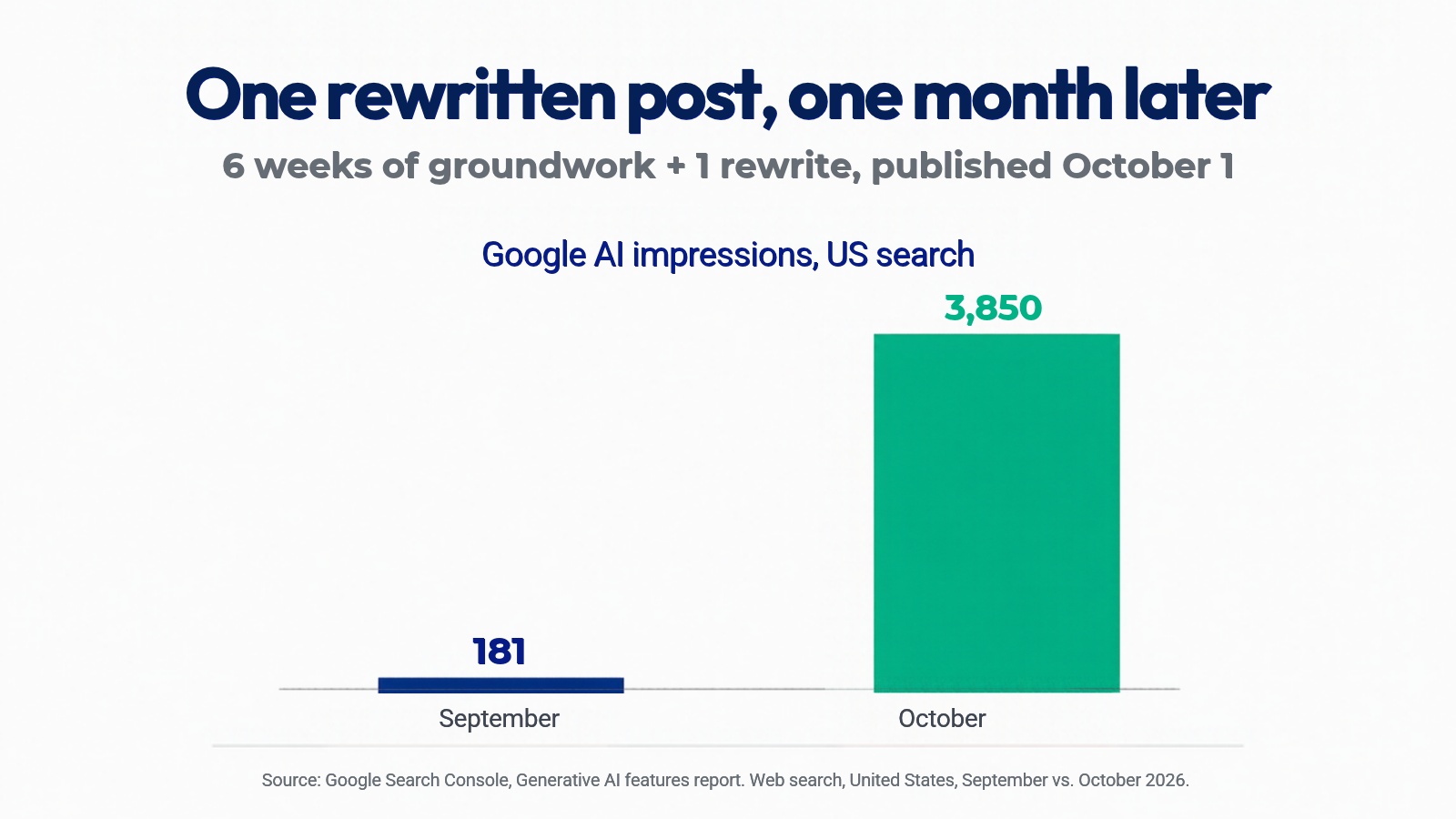
Timing, the rewrite, and the groundwork worked together. The rewrite was ordinary good marketing, a clear answer written for the people asking, and the groundwork was the technical housekeeping that let search engines and AI find it.
Writing for AI is a good reason to write for every reader
Much of what AI says about you comes from places you don't control, so start with what you do control, your own pages. Is the story clear? Is it in your audience's words? Does it work for the different ways people read? Pull up the last page or post you published and read it as each of these readers.
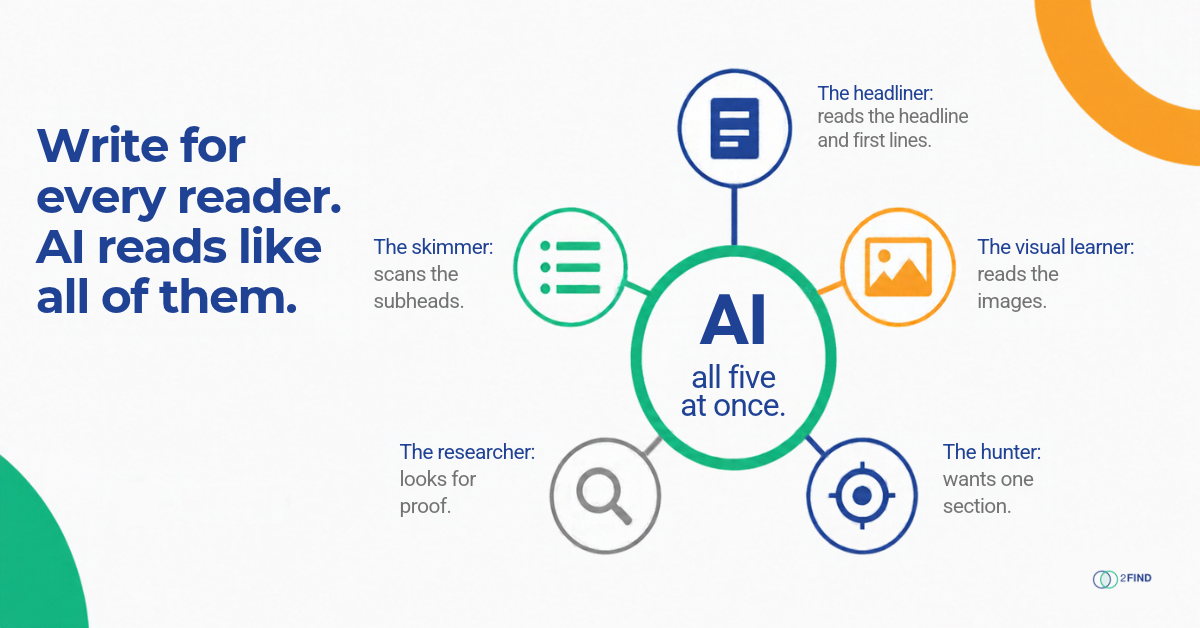
- The headliner reads on a phone while waiting for the next thing to start. Do the headline and the first few sentences answer the question the page is about? Give them the answer, and put the detail below.
- The skimmer scrolls looking for something interesting. Do the subheads carry the story, does a graphic catch the eye, and is there a summary at the end that tells the full tale?
- The visual learner takes in graphics, photos, layout, and color. Does the image tell the story, and does it help answer the page's question?
- The researcher often already has a reason to be there and wants detail and proof. Citable third-party facts are best. "We are the best" becomes "here are the customers who say we are the best," and numbers are even better.
- The hunter lands on one section looking for one specific point, which may not be the one you think matters most. Does that section stand on its own, or does it only make sense after reading the whole page?
Now add the newest reader, AI, which reads like all of them at once. As a headliner, it checks whether your headline and opening paragraph answer its question. Dan Petrovic at DEJAN, who reverse-engineered how Google builds its AI answers, found that opening paragraphs were pulled almost wholesale. As a skimmer, it scans your headings for the section that helps, and as a hunter, it pulls that one section, so give it sections that stand on their own. As a researcher, it looks for proof. In a small study of AI citations, Bart Magera at Advanced Web Ranking found that none of the passages Google showed without crediting contained a hard number or a new claim, and the credited passages carried a recent date, named the organization at first mention, and got specific. Facts help the people and the bots alike.
Getting found takes a lot of small things, done everywhere, the same way
This is the part of the work that is new for most marketing teams, and it has an end. Once the content is on your site, people and AI still have to find it, and there is no silver bullet. It is a lot of small things: tying each article to an author whose profile shows their expertise, writing page titles that match what people search for, getting right the technical details search engines read, and making sure new pages land in the feeds Google and Bing pick up. As Advanced Web Ranking's conversation with Natzir Turrado puts it, useful, current content can be found when AI systems search the web, so the basics of search engine optimization still count. Ranking first matters less than showing up at all. For the SaaS company, this was the six weeks before the rewrite.
Consistency is what makes the small things add up. Think about your address. It is on business cards, invoices, quotes, directories, email signatures, your website, and social media, and you make sure it is the same everywhere, because a customer who finds a different one will hesitate or end up at the wrong door. Your messaging works the same way: who you are, who you serve, and how you help should read the same wherever someone, or something, looks. I wrote about what happens when it doesn't in Why AI Is Getting Your Organization's Information Wrong.
Measure each piece, then judge by the results that matter
Measuring AI the way you measure search or paid media will frustrate you. The technology is new, and AI works more like brand marketing, where you often won't know when or where your content shaped an answer. The question someone types into a chatbot might be their first discovery of you, a follow-up to one of your campaigns, or a shopper standing in front of your product asking for more about it.
Start with the business goals: revenue, margin, leads, appointments, and customers (new, returning, and lost). Then work upstream through what you can measure today, watching ratios as well as totals. If AI answers the question people used to visit your site for, traffic can fall while your message spreads, and if your story is good but underexposed, traffic can rise. The SaaS numbers above are indicators, and the work there now is connecting them to new customers, which is the result that counts.
Good marketing is still how you get found
Everything the VP has spent decades doing still does the heavy lifting. AI adds new places to show up and new numbers to watch, and the organizations already telling their story clearly, in their audience's words, have a head start. You can exhale. You haven't been doing it wrong, and time hasn't passed you by, because AI is a new technology layered on top of what has always been good marketing.
For the groundwork, Build the Foundation Your Organization Needs to Be Found in Search and AI covers where to start. If you're asking the same question the VP was, start a conversation.
Ted Fay is a marketing consultant and founder of 2 Find Marketing. He writes about AI search, structured data, and practical implementation for marketing leaders. Away from work, he rides with Chicago Rando.
More in /learn · Connect on LinkedIn
Related in this series:
Why AI Is Getting Your Organization's Information Wrong
Build the Foundation Your Organization Needs to Be Found in Search and AI